
YAC-OSP Godly Leadership and Integrity in Church Administration
This course equips church leaders and administrators with biblical principles and practical governance tools to manage church resources with integrity. It covers common corruption risks, financial controls, transparency, legal compliance, and ethical leadership. Learners will conduct a church finance self-audit and propose reforms. The course promotes accountable stewardship, protects donor trust, and strengthens the church's witness in Ghana.
If the issue persists, kindly contact request@osp.gov.gh for assistance.
Course Modules
📌 How This Course Works
- Complete each lesson in order — the next lesson unlocks after you finish the previous one.
- After completing all 3 modules, the final quiz will unlock.
- Score 17 out of 20 or more to earn your certificate.
- Your progress is automatically saved in your browser.
A Prophetic Call
Beloved servants of God, grace and peace be multiplied to you. We live in an era where the world is crying out for integrity, transparency, and accountability. The Youth Against Corruption (YAC) have recognised this urgent need and developed platforms to combat corruption, promote integrity, and advance good governance. Yet, while the world seeks solutions, the Church — the very institution called to be the "pillar and ground of the truth" (1 Timothy 3:15) — must not be found wanting.
The Church Is Not Immune
The Church is not immune to corruption. In fact, when corruption enters the Church, it does greater damage than in any secular institution because it profanes the name of God, destroys the faith of the innocent, and robs the poor of their inheritance.
What Is Corruption?
Corruption is the abuse of entrusted power for private gain. In theological terms, it is the perversion of sacred trust — taking what belongs to God and His people and redirecting it for selfish purposes.
The Greek word for "corrupt" is diaphtheirō, meaning to destroy, ruin, or spoil. Biblically, corruption is not limited to stealing money; it includes any distortion of justice, truth, or love for personal advantage.
Key Scripture
You shall not steal; you shall not deal falsely; you shall not lie to one another.
Not an Administrative Error — a Sin
When a church leader uses their position to enrich themselves, favour their family, manipulate processes, or hide financial truths, they are not merely committing an administrative error — they are sinning against God and violating the sacred covenant of leadership.
What God Expects of Leaders
Before we examine corruption, we must understand what God expects from those who lead His people.
A. Leaders Are Stewards, Not Owners
Moreover, it is required of stewards that they be found faithful.
The church does not belong to the pastor, the board, or the denomination. It belongs to Christ. Every leader is a steward — someone who manages another's property. A steward who treats the Master's property as their own is a thief.
B. Leaders Must Be Above Reproach
An overseer must be above reproach, the husband of one wife, sober-minded, self-controlled, respectable, hospitable, able to teach, not a drunkard, not violent but gentle, not quarrelsome, not a lover of money.
The phrase "not a lover of money" (aphilargyros) means not greedy for financial gain. A leader who sees their position as an opportunity for financial benefit has already disqualified themselves.
C. Leaders Must Be Just and Transparent
You shall do no injustice in court. You shall not be partial to the poor or defer to the great, but in righteousness shall you judge your neighbor.
Justice in the church is not optional. Whether in hiring, procurement, discipline, or resource distribution, partiality and secret deals are an abomination to the Lord.
Module 1 Complete
You have laid the foundation: what corruption is in biblical terms, and the three marks God requires of those who lead His people. In Module 2 we look honestly at how corruption actually shows up in church administration.
Corruption Wears Many Masks
Let us be brutally honest and practical. Below are real-life manifestations that every leader must recognise and reject.
1. Tender Manipulation and Kickbacks
A church needs to renovate its building or purchase equipment. The finance officer or procurement committee invites contractors to submit tenders. After the evaluation, the officer approaches the winning contractor secretly and negotiates a "cut" or kickback. To facilitate this, the officer insists that payment be made in cash so that the skimmed amount can be removed before the money reaches the church account. Alternatively, the money is paid into the company's account, and the officer later visits the contractor to collect their share without any disclosure to the church members or board.
Biblical Parallel — Gehazi: The servant of Elisha ran after Naaman and lied to obtain silver and garments for himself. Elisha confronted him: "Is it a time to receive money and to receive clothing and olive orchards and vineyards and sheep and oxen and male servants and female servants? Therefore the leprosy of Naaman shall cling to you and to your descendants forever." (2 Kings 5:26-27). Gehazi lost his integrity, his health, and his legacy for a bribe.
2. Inflated Budgets
A leader prepares a budget for a church project — a mission trip, a building project, or a conference. The actual cost is known, but the budget is deliberately inflated. The excess is either diverted to personal use or used to fund unauthorised expenses. When members sacrificially give their tithes and offerings, believing they are building God's house, they are unknowingly funding someone's private lifestyle.
Biblical Parallel — Judas Iscariot: The treasurer for Jesus and the disciples. "He was a thief, and having charge of the moneybag, he used to help himself to what was put into it." (John 12:6). Judas betrayed Jesus for thirty pieces of silver — the price of a slave. His love of money made him a traitor.
3. Nepotism and Favouritism in Church Trips and Programmes
The church organises a mission trip or a conference. The leader ensures that friends and family members are added to the list without paying the required fees, while ordinary members who cannot afford it are excluded. Resources meant for the kingdom are used to maintain personal social networks.
Biblical Parallel — James 2:1-4: "My brothers, show no partiality as you hold the faith in our Lord Jesus Christ… if you pay attention to the one who wears the fine clothing and say, 'You sit here in a good place,' while you say to the poor man, 'You stand over there,'… have you not then made distinctions among yourselves and become judges with evil thoughts?"
4. Undisclosed Conflict of Interest
A church leader owns a business or has a relative who does. Church contracts are awarded to that business at inflated prices. The leader benefits personally while pretending to serve the church's best interest. The congregation is never informed of the relationship.
Biblical Parallel — Samuel's sons: When Samuel was old, he appointed his sons as judges, but they turned aside after dishonest gain. The elders of Israel said, "Behold, you are old and your sons do not walk in your ways. Now appoint for us a king…" (1 Samuel 8:5). Samuel's personal integrity was never questioned, but his sons' corruption damaged his legacy and led Israel to demand a monarchy.
5. Misuse of Church Property and Assets
Church vehicles are used for personal errands. Church halls are rented out, and the income is not declared. Church equipment "disappears" and is found in the leader's home. Tithes and offerings are diverted before they are recorded.
Biblical Parallel — Nehemiah: He discovered that some Jewish nobles were exacting usury from their own poor brothers and taking their fields, vineyards, and houses. "The thing that you are doing is not good. Ought you not to walk in the fear of our God to prevent the taunts of the nations our enemies?" (Nehemiah 5:9). He made them restore everything and took an oath from them.
6. Spiritual Manipulation for Financial Gain
Some leaders use the pulpit to manipulate members into giving money through false prophecies, emotional pressure, or threats of curses. They sell "anointing oil," "miracle water," or "prayer contracts" and enrich themselves while the poor suffer.
Biblical Parallel — Jesus cleanses the temple: The money changers and sellers had turned His Father's house into a "den of robbers" (Matthew 21:13). They were exploiting worshippers for profit. Jesus overturned their tables because corruption in God's house provokes divine anger.
Four Case Studies from Scripture
Scripture does not hide the cost of corruption. These four accounts show what happens when entrusted power is abused.
After the victory at Jericho, God commanded that all the spoils be devoted to Him. But Achan took a beautiful cloak, silver, and gold and hid them in his tent. Because of one man's secret sin, Israel was defeated at Ai, and thirty-six men died. When Achan was exposed, he and his entire family were stoned and burned. (Joshua 7:1-26)
Ananias and Sapphira sold a piece of property and brought part of the money to the apostles, pretending they had given the full amount. Peter confronted Ananias: "Ananias, why has Satan filled your heart to lie to the Holy Spirit and to keep back for yourself part of the proceeds of the land? … You have not lied to man but to God." Ananias fell down and died. Three hours later, his wife Sapphira came in, repeated the lie, and she too died. (Acts 5:1-11)
Balaam was a prophet who was offered money by Balak, king of Moab, to curse Israel. Though God prevented him from cursing Israel directly, Balaam taught Balak how to seduce Israel into immorality and idolatry, which brought a plague upon the people. Balaam's corruption was motivated by the wages of unrighteousness. (Numbers 22–25; 2 Peter 2:15; Jude 1:11)
Judas walked with Jesus for three years. He saw miracles, heard divine teaching, and was entrusted with the moneybag. Yet his heart was corrupt. He stole from the bag, and when Mary anointed Jesus with expensive ointment, Judas objected — not because he cared for the poor, but because he wanted the money for himself. His corruption culminated in betrayal for thirty pieces of silver. He later returned the money, went out, and hanged himself. (Matthew 26:14-16; 27:3-5)
Module 2 Complete
You can now recognise the six common masks of corruption in church administration and the biblical warnings that accompany each. Module 3 turns from warning to hope: the models of integrity, the true cost of corruption, and the call to restoration.
Four Models Worth Following
Scripture gives us not only warnings but examples — leaders who held sacred trust and did not abuse it.
Joseph was a slave in Potiphar's house. Potiphar's wife tried to seduce him day after day. Joseph refused, saying, "How then can I do this great wickedness and sin against God?" (Genesis 39:9). Even when he was falsely accused and imprisoned, Joseph maintained his integrity. Eventually, God exalted him to second-in-command over Egypt.
Daniel served in pagan administrations under multiple kings. His enemies could find no corruption in him because he was faithful, and "no error or fault was found in him" (Daniel 6:4). When they manipulated the king into a decree forbidding prayer, Daniel continued to pray openly. He was thrown into the lions' den, but God delivered him.
Nehemiah was appointed governor of Judah. Previous governors had placed heavy burdens on the people, taking food, wine, and silver from them. But Nehemiah said: "The former governors who were before me laid heavy burdens on the people and took from them for their daily ration forty shekels of silver. Even their servants lorded it over the people. But I did not do so, because of the fear of God." (Nehemiah 5:15). For twelve years, he did not take the governor's food allowance. He paid for his own expenses.
Jesus had every right to demand luxury and service, yet He said: "The Son of Man came not to be served but to serve, and to give his life as a ransom for many." (Matthew 20:28). He had nowhere to lay His head. He paid His taxes. He refused to turn stones into bread to satisfy His own hunger. He cleansed the temple because He loved God's house more than His own comfort.
Never a Victimless Crime
Corruption is never a victimless crime. Its consequences ripple outward like a stone thrown into a pond.
A Call to Repentance and Restoration
Beloved, the Church cannot preach against corruption in society while tolerating it in the sanctuary. We cannot teach our children to be honest while we secretly inflate budgets. We cannot ask the government to be transparent while our own financial records are hidden.
The world is watching. The Youth Against Corruption is building platforms to fight this evil. But the Church must lead the way — not because we fear exposure, but because we fear God.
Practical Safeguards
Biblical stewardship requires accountability. Multiple witnesses, separation of duties, and external audits create systems where corruption is difficult to hide and easy to detect.
Fight the good fight of the faith. Take hold of the eternal life to which you were called and about which you made the good confession in the presence of many witnesses.
🎉 Congratulations — All 3 Modules Complete!
You have completed the YAC-OSP Godly Leadership and Integrity in Church Administration course. You are now ready for the final quiz. Score 16 out of 20 or higher to earn your certificate.
📝 Final Assessment Quiz
Test your understanding of YAC-OSP Godly Leadership and Integrity in Church Administration.
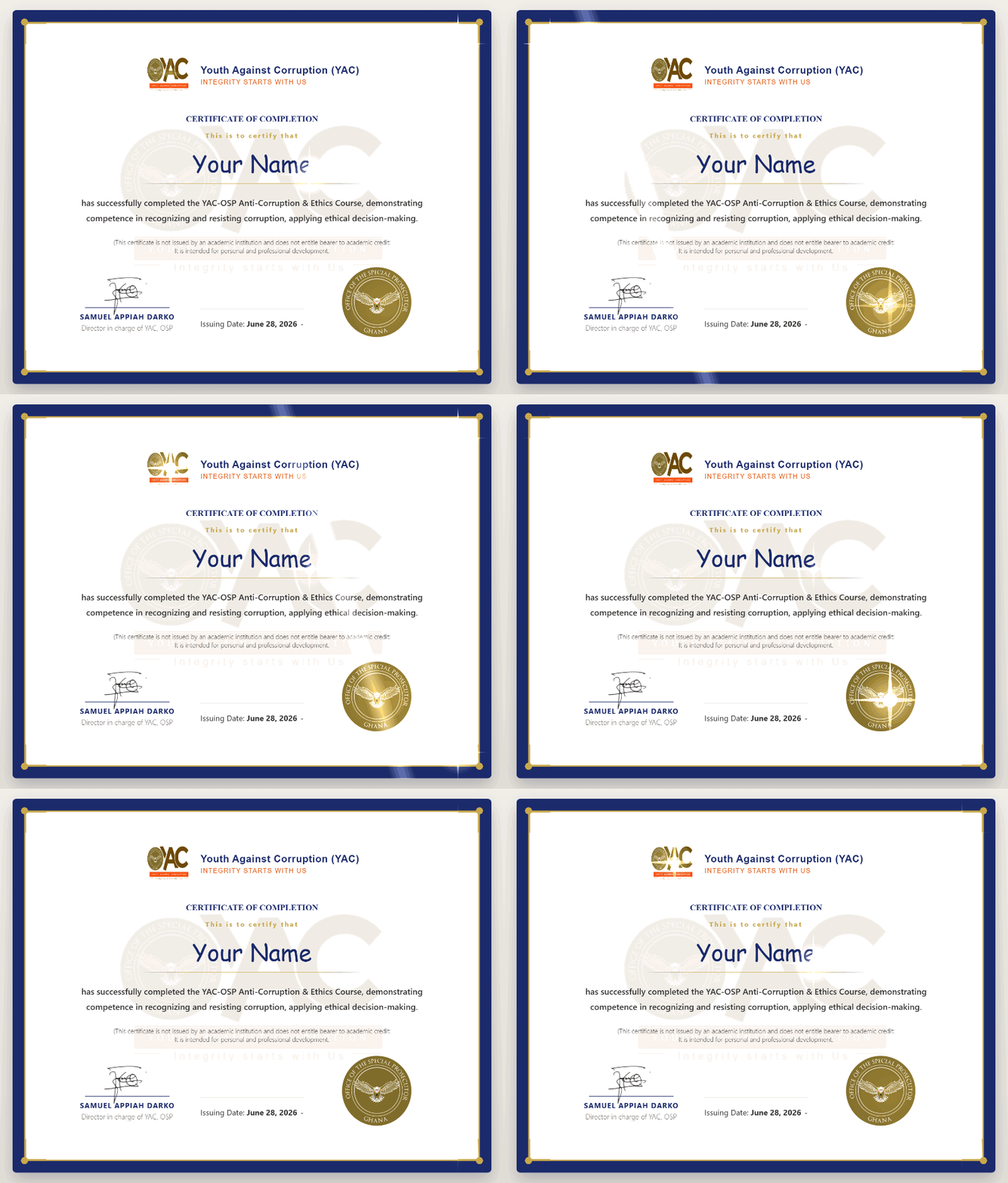
CERTIFICATE OF COMPLETION
This is to certify that
Eugene Fiifi Brown
has successfully completed the YAC-OSP Godly Leadership and Integrity in Church Administration, demonstrating competence in recognizing and resisting corruption, applying ethical decision-making.
(This certificate is not issued by an academic institution and does not entitle bearer to academic credit:
It is intended for personal and professional development.)

Samuel Appiah Darko Esq.
Director in charge of YAC, OSP